 GUIA

Comparativos y superlativos en inglés: reglas y usos
Los comparativos y los superlativos permiten establecer relaciones entre personas, animales, objetos, lugares o ideas. El comparativo relaciona normalmente dos elementos: Leah is taller than Nina significa «Leah es más alta que Nina». El superlativo presenta un elemento como poseedor de una cualidad en el grado máximo dentro de un grupo: Leah is the tallest student in her class equivale a «Leah es la estudiante más alta de su clase».

La elección entre -er, -est, more y most
En inglés, la forma depende sobre todo de la longitud del adjetivo, medida habitualmente por sus sílabas:
- Adjetivos cortos: los de una sílaba y muchos de dos sílabas terminados en -y. Forman el comparativo con -er y el superlativo con the ... -est.
- Adjetivos largos: los de dos sílabas que no terminan en -y y los de tres sílabas o más. Usan more en el comparativo y the most en el superlativo.
- Adjetivos irregulares: cambian de forma sin seguir estas pautas.
En las comparaciones de superioridad, el segundo elemento suele introducirse con than, nunca con that: The blue route is shorter than the red route. Si el contexto ya deja claro con qué se compara algo, la segunda parte puede omitirse: This route is shorter.
Comparativos y superlativos de adjetivos cortos
Con un adjetivo breve de una sílaba se añade -er para comparar y -est, precedido por the, para expresar el grado máximo.
- bright – brighter – the brightest
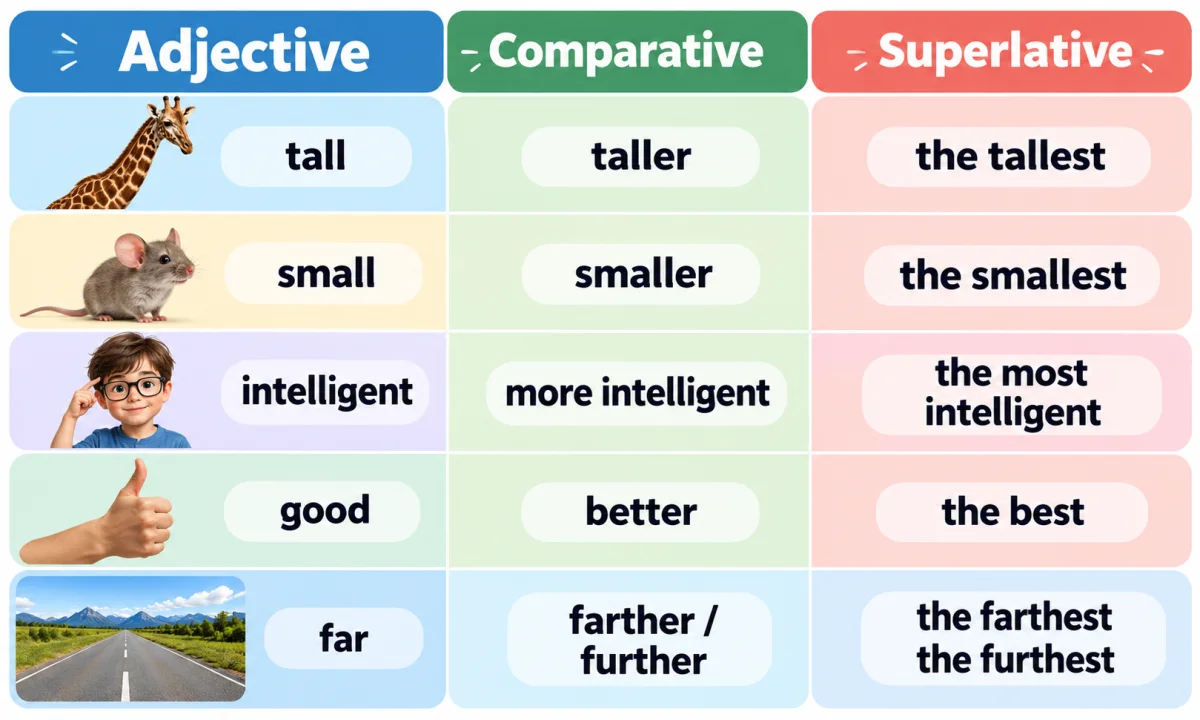
- small – smaller – the smallest
- long – longer – the longest
Por ejemplo, This cable is longer than the other one («Este cable es más largo que el otro») y That was the longest meeting of the week («Esa fue la reunión más larga de la semana»).
Cambios ortográficos frecuentes
Los adjetivos terminados en consonante más y cambian la y por i antes de añadir la terminación:
- easy – easier – the easiest
- busy – busier – the busiest
- healthy – healthier – the healthiest
Así, puede decirse The second exercise was easier than the first o Sunday was the busiest day at the market.
Cuando un adjetivo breve termina en una sola vocal seguida de una consonante, normalmente se duplica la consonante final:
- big – bigger – the biggest
- wet – wetter – the wettest
- thin – thinner – the thinnest
Estas formas aparecen, por ejemplo, en The north window is wetter than the south one y That is the biggest pumpkin in the exhibition.
Si el adjetivo ya termina en e, solo se agrega -r o -st, sin repetir la letra:
- wide – wider – the widest
- safe – safer – the safest
- large – larger – the largest
Por ejemplo: This seat is wider than the one near the door y That bridge is the safest crossing in the area.
Adjetivos largos: more y the most
Los adjetivos largos conservan su forma. El comparativo se construye con more + adjetivo y el superlativo con the most + adjetivo:
- careful – more careful – the most careful
- expensive – more expensive – the most expensive
- comfortable – more comfortable – the most comfortable
Algunos usos posibles son The electric train is more comfortable than the bus, This method is more effective than the previous one y That is the most expensive instrument in the collection. En el superlativo, the suele ser obligatorio porque se identifica un elemento como el máximo dentro de un conjunto: It was the most memorable concert of the festival.
Algunos adjetivos de dos sílabas admiten las dos construcciones, según el uso y la variedad del inglés: simple – simpler / more simple y quiet – quieter / more quiet. En general, la forma con -er es frecuente cuando resulta natural y fácil de pronunciar.
Formas irregulares
Algunos adjetivos tienen comparativos y superlativos propios:
- good – better – the best («bueno, mejor, el mejor»)
- bad – worse – the worst («malo, peor, el peor»)
- little – less – the least («poco, menos, el menos»)
- much/many – more – the most («mucho(s), más, la mayor cantidad»)
- far – farther/further – the farthest/the furthest («lejano, más lejano, el más lejano»)
Por ejemplo, This solution is better than the first one, Yesterday’s weather was worse than today’s y That was the best explanation in the lesson. En el caso de farther y farthest, son habituales para distancias; further también se emplea con el sentido de «adicional» o «más», especialmente en expresiones como For further details, read the notice («Para obtener más detalles, lea el aviso»).
Para hablar de la edad dentro de una familia, puede utilizarse elder en lugar de older, sobre todo delante de un sustantivo: Her elder sister studies medicine. No se emplea normalmente elder para comparaciones generales fuera de ese contexto familiar.
Comparaciones de superioridad en contexto
La estructura básica es sujeto + verbo + comparativo + than + término de comparación. El comparativo puede referirse a una cualidad, una cantidad o incluso a la manera de realizar una acción.
- A dolphin is more agile than a seal.
- My new desk is smaller than the old one.
- The evening train arrives earlier than the morning train.
- This fabric feels softer than that material.
- The northern road is less busy than the highway.
- Her second presentation was more convincing than her first.
- The blue notebook costs more than the green one.
- Our laboratory is cleaner than it was last month.
- These instructions are more useful than the previous ones.
- Rita speaks more clearly than her colleague.
- The new software runs faster than the old version.
- The museum is farther from the station than I expected.
La comparación también puede quedar incompleta cuando el referente es evidente: The second draft is clearer. En español, esta forma suele traducirse como «El segundo borrador es más claro», aunque el inglés no mencione explícitamente el otro borrador.
El grado de la diferencia
Los adverbios much, a lot y, en un registro informal, way, intensifican el comparativo. A little y a bit indican una diferencia pequeña:
- The revised map is much easier to read.
- Her apartment is a lot brighter than mine.
- This explanation is way more practical than the first one.
- The afternoon became a little colder than the morning.
- Today’s queue is a bit shorter than yesterday’s.
Para comparar adverbios, se utiliza more, incluso cuando el adverbio termina en -ly: The nurse worked more patiently than the volunteers («La enfermera trabajó con más paciencia que los voluntarios»). También se emplea more o less al comparar cantidades: We need more time than they do y The smaller box contains less sand than the larger one.
Inferioridad e igualdad
La inferioridad puede expresarse de dos maneras principales:
- not as + adjetivo + as: «no tan ... como».
- less + adjetivo + than: «menos ... que».
Por ejemplo, This fabric is not as thick as the winter fabric y The second route is less convenient than the first. Ambas construcciones comparan dos elementos, pero la primera niega que alcancen el mismo grado y la segunda afirma directamente que el grado es inferior.
La igualdad se forma con as + adjetivo + as, equivalente a «tan ... como»: The two instruments are as precise as each other. Otros ejemplos son My brother is as patient as our teacher y This shelter is as warm as the main building.
Cómo construir el superlativo
El superlativo suele incluir the y presenta un elemento como el que posee una cualidad en mayor grado dentro de un grupo. Con adjetivos cortos se usa the + adjetivo + -est; con adjetivos largos, the most + adjetivo.
- Lake Baikal is the deepest lake in the world.
- That sapling is the tallest tree in the garden.
- February was the driest month of the year.
- She chose the most reliable computer in the store.
- This is the most detailed map of the region.
- Orion is one of the most recognizable constellations in the night sky.
- That was the least comfortable chair in the room.
- He gave the most convincing answer during the debate.
- The archive contains the oldest document in the collection.
- It is the most unusual sculpture displayed at the gallery.
- She is the fastest runner on the relay team.
- This is the farthest point accessible by road.
La fórmula one of the + superlativo + sustantivo plural significa «uno de los más ...»: That architect is one of the most respected designers in the country. El sustantivo posterior debe aparecer en plural porque se selecciona un elemento perteneciente a un conjunto.
En ciertos casos, el superlativo no necesita un sustantivo expreso si el contexto lo proporciona: Of all the available options, this costs the least («De todas las opciones disponibles, esta es la que cuesta menos»). También son habituales expresiones como You are the best! o That was the worst!, en las que el referente se sobreentiende.
Vídeo explicativo
Autor
 Clara Bennett
 ha desarrollado su trayectoria en torno al inglés, la enseñanza de idiomas y la divulgación cultural. Su interés se centra en la gramática, el vocabulario, la comprensión y el uso práctico de la lengua, explicando cada concepto de forma clara, cercana y accesible para todo tipo de público.